Mechanical Vibrations
Split Harmonic Motion into Two Harmonic Motions
Question
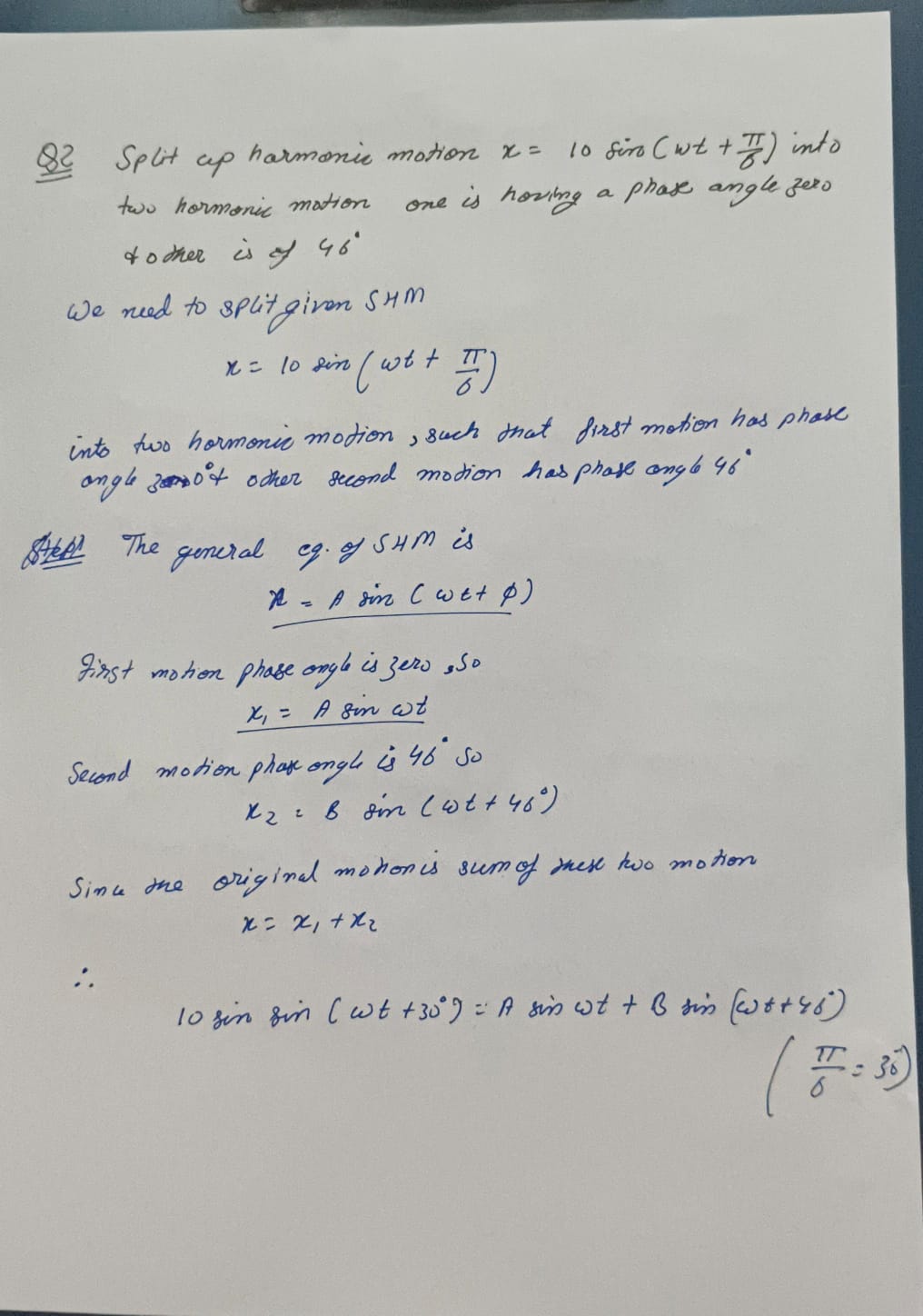
Split the harmonic motion x = 10 sin(ωt + π/6) into two harmonic motions, one having a phase angle of zero and the other of 46°.
Answer
Solution
The given harmonic motion is:
x = 10 sin(ωt + π/6)
Since
π/6 = 30°
Therefore,
x = 10 sin(ωt + 30°)
Step 1: Write the two harmonic motions
The first motion has a phase angle of 0°:
x1 = A sin(ωt)
The second motion has a phase angle of 46°:
x2 = B sin(ωt + 46°)
Since the original motion is the sum of these two motions:
x = x1 + x2
Therefore,
10 sin(ωt + 30°) = A sin(ωt) + B sin(ωt + 46°)
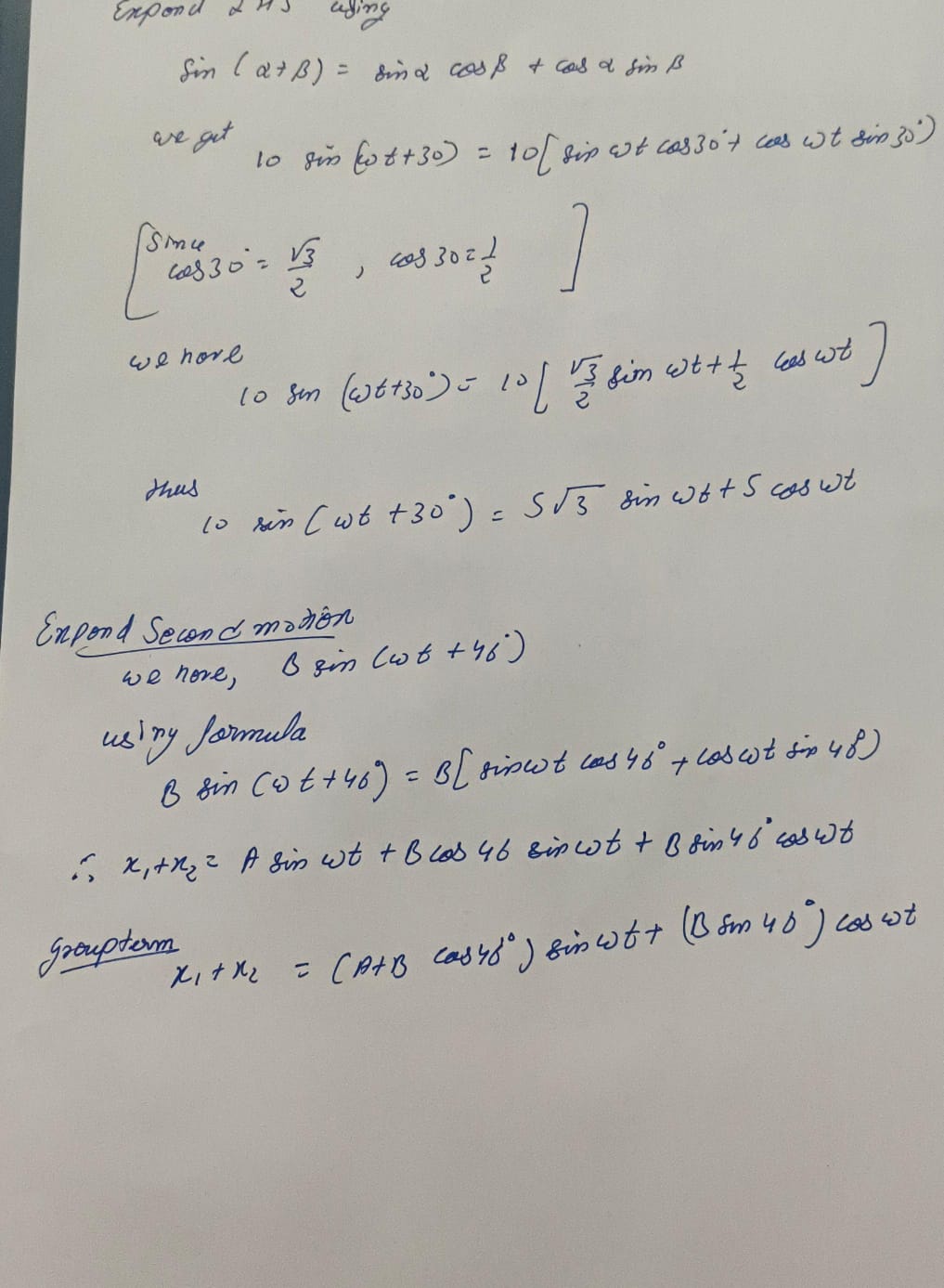
Step 2: Expand the left-hand side
Using the identity:
sin(α + β) = sinα cosβ + cosα sinβ
We get:
10 sin(ωt + 30°) = 10[sin(ωt) cos30° + cos(ωt) sin30°]
Since:
cos30° = √3/2
sin30° = 1/2
Therefore:
10 sin(ωt + 30°) = 5√3 sin(ωt) + 5 cos(ωt)
Step 3: Expand the second motion
We have:
B sin(ωt + 46°)
Using the same identity:
B sin(ωt + 46°) = B[sin(ωt) cos46° + cos(ωt) sin46°]
Therefore:
x1 + x2 = A sin(ωt) + B cos46° sin(ωt) + B sin46° cos(ωt)
Grouping the terms:
x1 + x2 = (A + B cos46°) sin(ωt) + B sin46° cos(ωt)
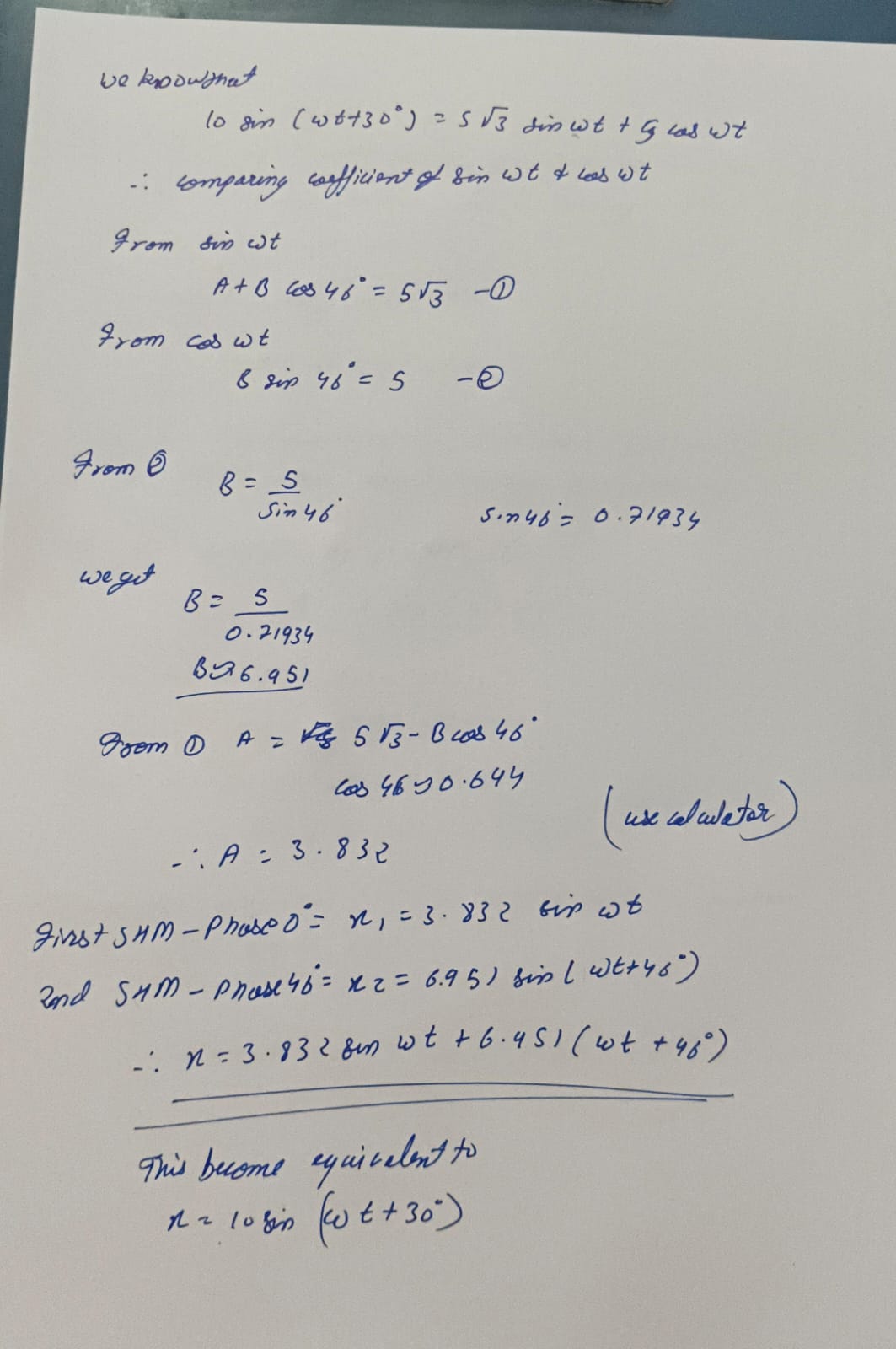
Step 4: Compare the coefficients
We have:
5√3 sin(ωt) + 5 cos(ωt)
Comparing the coefficients of sin(ωt):
A + B cos46° = 5√3
Comparing the coefficients of cos(ωt):
B sin46° = 5
Step 5: Find B
From:
B sin46° = 5
Therefore:
B = 5 / sin46°
Using:
sin46° ≈ 0.71934
We get:
B ≈ 6.951
Step 6: Find A
From:
A + B cos46° = 5√3
Therefore:
A = 5√3 - B cos46°
Substituting the value of B:
A = 8.6603 - (6.951)(0.6940)
Therefore:
A ≈ 3.832
Final Answer
The first harmonic motion having phase angle 0° is:
x1 ≈ 3.832 sin(ωt)
The second harmonic motion having phase angle 46° is:
x2 ≈ 6.951 sin(ωt + 46°)
Hence:
x ≈ 3.832 sin(ωt) + 6.951 sin(ωt + 46°)
which is equivalent to:
x = 10 sin(ωt + 30°)